Overview
Functional Assessment 1&2
(Eight days)
Functional Assessment takes the principles explored in The Running Body beyond running and into the assessment of all human movement. It is a practical, clinically applicable approach to examining how the body organises itself in response to gravity, ground reaction forces and the demands of movement.
Rather than providing a collection of ideal postures, movement patterns or treatment protocols, the course develops a way of critically analysing the moving body. It encourages practitioners to understand movement without judgement, to recognise the relationships between different parts of the body, and to develop and test hypotheses about why a particular movement pattern has emerged.
The body is not a collection of independent parts, and movement problems rarely originate where they are felt. Functional Assessment therefore takes a whole-systems approach, examining the relationships between joints, muscles, fascia, alignment, force distribution and neuromuscular control. The aim is not simply to identify an asymmetry or an apparent dysfunction, but to understand how the different elements of the system interact and influence one another.
The assessment is grounded in real anatomy and real movement. It considers how the body responds to gravity and ground reaction forces, how load is distributed through the musculoskeletal system, and how the body adapts to maintain function. Rather than following pain or assuming that the most obvious finding is the source of the problem, practitioners are encouraged to investigate the body as a complex system and identify where a particular compensation may have begun.
At the heart of the approach is the same attitude of suspended conclusion described in The Running Body: observe, question, hypothesise, test and retest. The assessment is deliberately flexible, allowing the practitioner to respond to the individual in front of them and to refine their understanding as new information emerges.
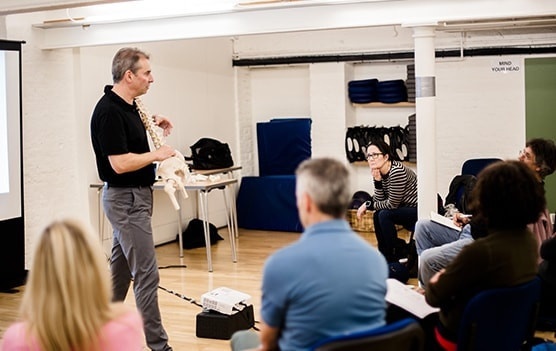
The workshop combines theoretical and practical learning to develop the practitioner’s ability to see, describe and interpret movement. Participants will learn to:
- Describe postural and movement patterns without judgement.
- Recognise relationships and compensations within the musculoskeletal system.
- Investigate potential starting points for biomechanical compensations rather than simply following pain.
- Distinguish between a contributing factor, a compensation and the response of the system.
- Develop and test individualised clinical hypotheses.
- Use movement assessment to inform personalised treatment and rehabilitation strategies.
The techniques can be applied on the treatment table, in standing and during movement, providing a practical framework that can be incorporated into everyday clinical practice. Functional Assessment will complement, rather than replace, your existing skill sets.
As explained in The Running Body, this course is ultimately less about teaching practitioners what to see than teaching them how to look. The deeper purpose is to develop clinical evaluative skills to discover how an individual body has organised itself.
Running provides one context in which these principles can be explored. Movement provides the larger subject. Functional Assessment takes the same systems-based, hypothesis-driven approach and applies it to the body as a whole.
The workshops can be seen as a pair that will help you toward the full Functional & Integrative Bodywork Diploma, or can be taken individually.